
What Is an Extensive Green Roof?
An extensive green roof is a lightweight, low-maintenance roof system designed to support vegetation while providing a range of environmental and practical benefits.
Unlike more intensive green roofs, which can support deeper growing mediums, shrubs and even small trees, extensive green roofs are designed around a relatively shallow growing medium and low-growing vegetation such as sedum, wildflowers or other suitable plants.
They can be used on a wide range of buildings, from commercial and industrial developments to offices, residential properties, garages and other structures where the roof has been designed to accommodate a green roof system.
How does an extensive green roof work?
An extensive green roof is made up of several layers, each with a specific purpose.
Typically, a green roof system will include:
Vegetation – the living layer that provides the visible green roof, such as sedum or suitable wildflower vegetation.
Growing medium/substrate – a lightweight growing medium that provides the vegetation with the physical support, moisture and nutrients it needs.
Drainage layer – allows excess water to drain away while helping retain some moisture within the system.
Protection and waterproofing layers – protect the roof structure and waterproofing system beneath the green roof build-up.
The exact specification will depend on the building, roof construction, pitch, loading capacity, drainage requirements and the type of vegetation being used.
Why choose an extensive green roof?
Green roofs can provide benefits beyond simply adding vegetation to a building.
Helps manage rainfall
The vegetation and growing medium can retain and absorb some rainfall, slowing the rate at which water reaches the drainage system.
This can be particularly useful as part of wider sustainable drainage and water-management strategies.
Supports biodiversity
Depending on the vegetation selected, an extensive green roof can provide food and habitat for insects and other wildlife.
A green roof doesn't have to be planted exclusively with sedum. Other vegetation choices, including suitable wildflower mixes, can provide opportunities to increase the diversity of species supported by the roof.
Helps reduce the visual impact of buildings
Green roofs can soften the appearance of roofs and built environments, particularly where buildings are overlooked from surrounding properties or higher ground.
They can also help integrate new developments into their surroundings.
Provides additional green space
Where ground-level space is limited, a green roof can introduce vegetation into areas that would otherwise be dominated by hard surfaces.
This makes green roofs particularly interesting for urban developments where opportunities for creating additional green space can be restricted.
Can contribute to wider sustainability objectives
Green roofs can form part of a wider approach to sustainable landscape and building design, alongside measures such as sustainable drainage, biodiversity enhancement and habitat creation.
However, the benefits of a green roof depend on the design and specification of the complete system rather than simply adding vegetation to a roof.
Extensive vs intensive green roofs
The main difference between extensive and intensive green roofs is the depth of the growing medium, the type of vegetation they can support and the level of maintenance required.
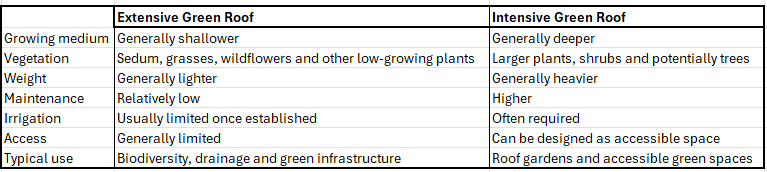
It is important to remember that “extensive” does not mean maintenance-free. All green roofs require some level of inspection and maintenance to ensure the vegetation remains healthy and drainage systems continue to function correctly.
What vegetation can be used on an extensive green roof?
Sedum is commonly associated with extensive green roofs because it is well suited to relatively shallow growing conditions and can cope with periods of dry weather once established.
However, it isn't the only option.
Depending on the depth and specification of the system, other vegetation can be considered, including grasses, herbs and wildflowers.
At Lindum, we are particularly interested in developing green roof systems that provide greater opportunities for biodiversity while reducing reliance on plastic-based materials.
Our approach is rooted in our experience as a UK turf grower: rather than simply looking at the vegetation layer in isolation, we consider how the growing medium, drainage and vegetation work together as part of a complete system.
How much maintenance does an extensive green roof need?
One of the attractions of an extensive green roof is that it generally requires less maintenance than an intensive roof garden.
However, it should not be considered maintenance-free.
Regular inspections should be carried out to check the condition of the vegetation, drainage outlets and other elements of the roof system. Any unwanted vegetation should be removed before it becomes established, and damaged areas should be repaired or replanted where necessary.
The level of maintenance required will depend on the roof design, vegetation, location and environmental conditions.
Can an extensive green roof be installed on any roof?
Not necessarily.
Before specifying or installing a green roof, the building and roof structure need to be assessed to make sure they are suitable for the additional loading and the proposed system.
Factors such as:
roof pitch
structural loading capacity
waterproofing
drainage
access
wind exposure
fire performance
vegetation
growing medium depth
all need to be considered.
For new developments, it is generally best to consider the green roof at the design stage rather than trying to add one after construction.
Extensive green roofs and biodiversity
Not all green roofs provide the same ecological value.
A simple sedum roof can provide valuable vegetation and habitat, but incorporating a greater diversity of plants and habitats can create additional opportunities for wildlife.
This is why the choice of vegetation and substrate matters.
For projects where biodiversity is a key objective, a species-rich or wildflower approach may be worth considering, subject to the requirements of the roof and the appropriate technical specification.
Choosing the right green roof system
There isn't a single green roof solution that is right for every project.
The best approach will depend on what the roof needs to achieve.
For some projects, a lightweight sedum system may be the most appropriate option. For others, a more diverse vegetation layer may provide greater biodiversity benefits.
The important thing is to consider the complete roof build-up, rather than choosing the vegetation separately.
At Lindum, we grow and supply vegetation for green roof systems and can work with landscapers, contractors, architects and specifiers to help identify a suitable approach for a project.
Looking to specify an extensive green roof?
Whether you're working on a commercial development, residential project, public space or landscape scheme, choosing the right vegetation and system from the outset can make a significant difference to the long-term performance of a green roof.
Talk to Lindum about your green roof project and find out more about our green roof vegetation and system options.